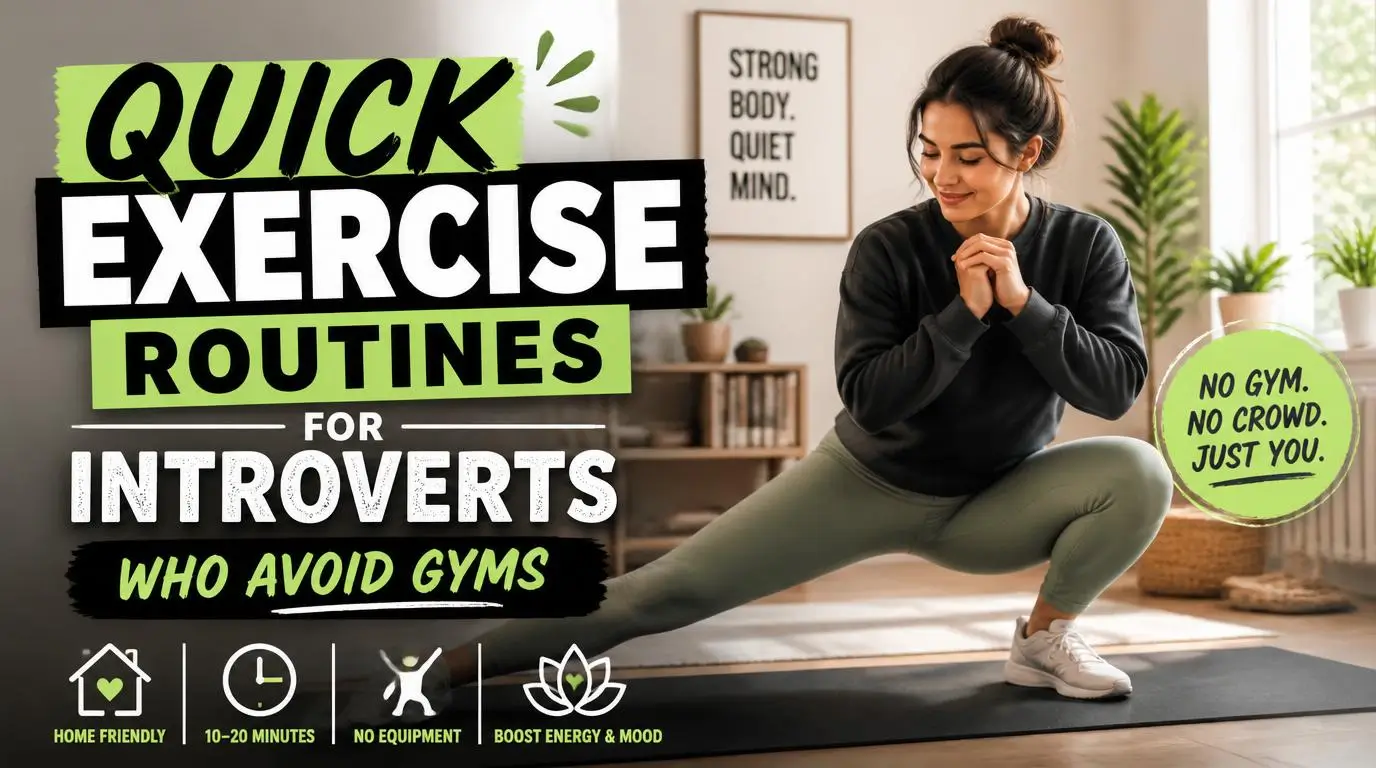
If you’ve ever driven to a gym, sat in the parking lot, and then just drove home, you already understand why quick exercise routines for introverts who avoid gyms exist. I did that three separate times before canceling my membership entirely. The crowds, the small talk, someone waiting for your machine. It all felt like a social event I never signed up for. Turns out, I didn’t need a gym at all. I just needed the right approach at home.
1. The 10-Minute Bodyweight Morning Flow
Starting the day with movement before the world gets loud is an introvert superpower. I roll out of bed, grab a yoga mat, and do a simple bodyweight circuit: 10 pushups, 15 squats, a 30-second plank, and 10 lunges per leg. No equipment. No shoes. No one watching.
The trick is keeping it short enough that you never dread it. Ten minutes feels almost too easy, which is exactly why you actually do it. I’ve been more consistent with this routine than any gym plan I ever paid for. Your living room carpet works fine if you don’t own a mat.
2. Resistance Band Workouts in Your Bedroom
Resistance bands cost about $15 for a full set, take up zero space, and deliver a surprisingly intense workout. I keep mine in my nightstand drawer. My go-to session is banded rows, lateral walks, overhead presses, and bicep curls, all done in about 15 minutes.
What makes bands perfect for introverts is the silence. No clanking weights, no mirrors reflecting a room full of strangers. Just you and a stretchy piece of rubber. Brands like Fit Simplify and SPRI sell solid starter sets on Amazon. I’ve had my Fit Simplify set for over two years and they still snap back like new.
3. Walking with Headphones (The Introvert’s Cardio)
Walking doesn’t get enough credit as real exercise. A brisk 20-minute walk at a pace where you’re slightly out of breath burns calories, clears your head, and requires absolutely no social interaction. Pop in your AirPods, pick a podcast or playlist, and go.
I walk early mornings or late evenings when sidewalks are empty. That timing matters. Peak hours feel like dodging conversations at a party. Off-peak hours feel like the entire neighborhood belongs to you. If it’s raining, I pace my apartment hallway. Weird? Maybe. Effective? Absolutely.
4. YouTube Follow-Along Routines (No Instructor Eye Contact)
YouTube channels like Grow with Jo, HASFIT, and Caroline Girvan offer full workout routines you can follow from your living room. You press play, you move, you press stop. Nobody corrects your form out loud in front of a class.
I personally rotate between Grow with Jo for cardio days and Caroline Girvan for strength days. The production quality is high enough to keep you engaged, and most videos run between 15 and 30 minutes. Pause whenever you want. Nobody notices. That freedom makes all the difference when you’re someone who hates being watched while exercising.
5. Jump Rope Sessions in Your Garage or Backyard
A speed rope and about six square feet of space is all you need for one of the most efficient cardio workouts that exists. Five minutes of jump rope gets your heart rate up faster than 15 minutes on a treadmill. I do three-minute rounds with 30-second rest breaks, aiming for five rounds total.
The garage is my spot because it’s private and the ceiling is high enough. A driveway or backyard works too. The Crossrope brand makes weighted ropes that add a strength element, but a basic $8 speed rope from any sporting goods store does the job. Just watch out for low-hanging light fixtures. I learned that one the hard way.
Quick Exercise Routines for Introverts Who Prefer Quiet Strength Training
Not every introvert wants cardio. Some of us just want to get stronger without a spotter breathing over our shoulder. A pair of adjustable dumbbells, like the Bowflex SelectTech or the much cheaper Yes4All spinlock set, opens up dozens of strength movements at home.
My favorite minimal routine takes 20 minutes: goblet squats, dumbbell rows, overhead press, Romanian deadlifts, and floor press. Three sets of 10 reps each. I rest 60 seconds between sets, which keeps things moving without feeling rushed.
Why Home Strength Training Works for Quiet People
The gym puts strength training on display. At home, you can grunt, fail a rep, or take a long rest without anyone noticing. That low-pressure environment actually helps you push harder because self-consciousness isn’t eating into your focus. I lift heavier at home than I ever did at a commercial gym, purely because my mental energy goes toward the workout instead of managing my surroundings.
6. Yoga with an App Instead of a Studio
Studio yoga classes can feel intense for introverts. The close quarters, the instructor adjusting your body, the group breathing exercises. An app like Down Dog or the free Yoga with Adriene channel on YouTube gives you the same practice without the social packaging.
I use Down Dog because it generates a different sequence every time, so I never get bored. Sessions range from 10 to 60 minutes, and you pick the style, pace, and focus area. Restorative yoga before bed has done more for my sleep than melatonin ever did. And nobody tells me to “connect with my neighbor’s energy.”
7. Stair Workouts Inside Your Own Home
If you have a staircase, you have a cardio machine. Walking up and down stairs for 10 minutes straight is a legitimate workout. Add variations like skipping every other step, doing calf raises on the bottom stair, or carrying a heavy backpack, and you’ve got a full lower-body session.
I started doing this during winter when outdoor walks felt brutal. It felt almost silly at first, but my legs were sore the next day, which told me everything I needed to know. Apartment building? Your building’s stairwell at a quiet hour works perfectly. Most people take the elevator, so you’ll likely have it to yourself.
8. Dance Workouts Behind Closed Doors
This one sounds ridiculous until you try it. Put on a high-energy playlist, lock your door, and just move for 15 to 20 minutes. No choreography needed. No rhythm required. Just keep your body moving fast enough to sweat.
If freeform dancing feels too chaotic, apps like Just Dance (available on Nintendo Switch and other consoles) give you structure with scored routines. I’d never do this in front of another human being, but alone in my living room, it’s genuinely the most fun workout I do all week. Calories burned don’t care about your dignity.
9. The Tabata Protocol (Four Minutes, Done)
Tabata is a brutally efficient format: 20 seconds of all-out effort, 10 seconds of rest, repeated 8 times. Total time, four minutes. Pick one exercise like burpees, mountain climbers, or squat jumps. Set a Tabata timer on your phone (the Tabata Timer app is free), and go.
Four minutes sounds like nothing. It is not nothing. The first time I did Tabata burpees, I collapsed on my kitchen floor afterward and stayed there for a solid minute. But that intensity means you can squeeze a real workout into the smallest gap in your day. Perfect for introverts who want minimal time spent “working out” so they can get back to their quiet evening.
10. Evening Stretching as a Wind-Down Ritual
Stretching often gets dismissed as “not real exercise,” but a dedicated 15-minute stretching session improves flexibility, reduces injury risk, and calms your nervous system. For introverts who feel overstimulated by the end of the day, this is gold.
I do hip openers, hamstring stretches, thoracic spine twists, and a long child’s pose every night before bed. No video needed once you learn the basics. The room is dim, my phone is across the room, and it’s the quietest part of my day. IMO, this single habit improved my overall fitness more than adding another intense workout ever could.
How to Build Consistency Without Gym Accountability
The biggest myth about gyms is that you need one for accountability. You don’t. You need a routine small enough that skipping it feels harder than doing it. That’s why most of these routines are under 20 minutes.
I track my workouts in a simple notes app on my phone. Nothing fancy. Just the date, what I did, and how it felt. After a few weeks, the streak itself becomes the motivation. Seeing “14 days in a row” makes you not want to break it.
Stack It Onto Something You Already Do
Habit stacking works incredibly well for home workouts. I do my bodyweight flow immediately after brushing my teeth every morning. The toothbrush is the trigger. The workout follows automatically. You can attach any of these quick exercise routines for introverts who avoid gyms to an existing habit, and the friction almost disappears.
Frequently Asked Questions
Can you actually get fit without going to a gym?
Yes, completely. Bodyweight training, resistance bands, dumbbells, and consistent cardio like walking or jump rope cover every fitness base. Plenty of people build impressive strength and endurance training exclusively at home. The gym offers convenience and variety, but it’s never been a requirement for real results. Your body doesn’t know or care where the resistance comes from.
What’s the shortest effective workout for someone who hates exercising?
The Tabata protocol takes just four minutes and delivers measurable cardiovascular benefits. Studies from the National Institute of Fitness and Sports in Japan back this up. Even a 10-minute bodyweight circuit done consistently outperforms a 60-minute gym session you skip three times a week. Consistency at low duration beats inconsistency at high duration every time.
Are quick exercise routines for introverts who avoid gyms actually enough to stay healthy?
Absolutely. The World Health Organization recommends 150 minutes of moderate activity per week. That’s roughly 20 minutes a day. Most routines listed here meet or exceed that threshold when done consistently. You don’t need two-hour sessions. You need regular movement that fits your personality and lifestyle without draining your social battery.
What equipment should I buy first for home workouts?
Start with a set of resistance bands and a yoga mat. Together they cost under $30 and enable dozens of exercises. If you want to add strength training later, a pair of adjustable dumbbells is the best next investment. Skip the fancy home gym machines until you’ve built a solid habit with the basics. Most of that expensive gear ends up as a clothes rack.
How do I stay motivated without a workout partner or trainer?
Track your workouts in a simple app or notebook and focus on streaks. FYI, visual progress like a calendar with check marks works better than vague goals. Set a tiny minimum, even five minutes counts, so you never have an excuse to skip. Motivation fades, but systems and low barriers keep you showing up long after the initial excitement wears off.
Is walking really considered a workout?
Brisk walking absolutely qualifies as moderate-intensity exercise. Research published in the British Journal of Sports Medicine links regular walking to reduced cardiovascular disease risk, improved mood, and better metabolic health. The key word is “brisk,” meaning a pace fast enough that talking feels slightly difficult. Casual strolling is great for mental health, but picking up the pace adds real physical benefits.
Conclusion
Fitness never required a gym membership, a spotter, or small talk with strangers between sets. It just required movement that fits your actual life. If any of these routines clicked with you, start with one tonight and see how it feels, what’s the one you’re most likely to actually try?